7 Jun 2026
Subscription Billing Cycles as Predictors of Stability in Merchant Financing Decisions
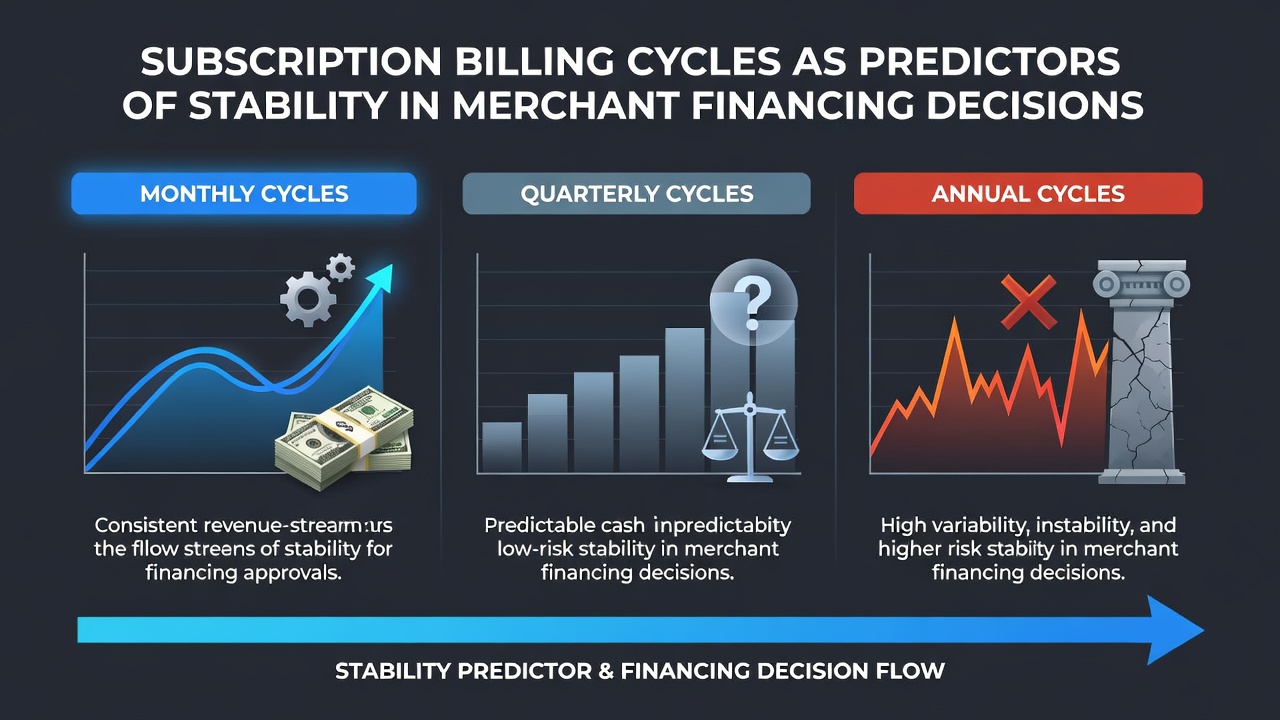
Subscription billing cycles operate as recurring revenue mechanisms that generate predictable cash flows for merchants across retail, software, and service sectors, and analysts have examined how these patterns serve as indicators when lenders evaluate financing applications. Data from various financial institutions shows that businesses maintaining consistent monthly or quarterly billing intervals often demonstrate lower default rates on loans compared to those relying on irregular transaction volumes, because the steady inflows allow for more reliable debt servicing projections. Researchers at institutions like the Federal Reserve Bank of New York have tracked these correlations through aggregated merchant datasets, revealing that subscription models with annual renewal cycles tend to correlate with higher stability scores during underwriting reviews.
Mechanics of Subscription Billing in Revenue Forecasting
Merchants implement subscription billing through automated systems that charge customers at fixed intervals, which creates datasets lenders can analyze for retention metrics and churn rates. When cycles align with predictable renewal dates, such as the first of each month, the resulting revenue streams provide clear visibility into future inflows, allowing underwriters to model repayment schedules with greater precision. Studies from the Organisation for Economic Co-operation and Development indicate that European small businesses adopting quarterly billing cycles reported more consistent year-over-year growth in 2025, which in turn influenced their eligibility for working capital facilities from regional banks.
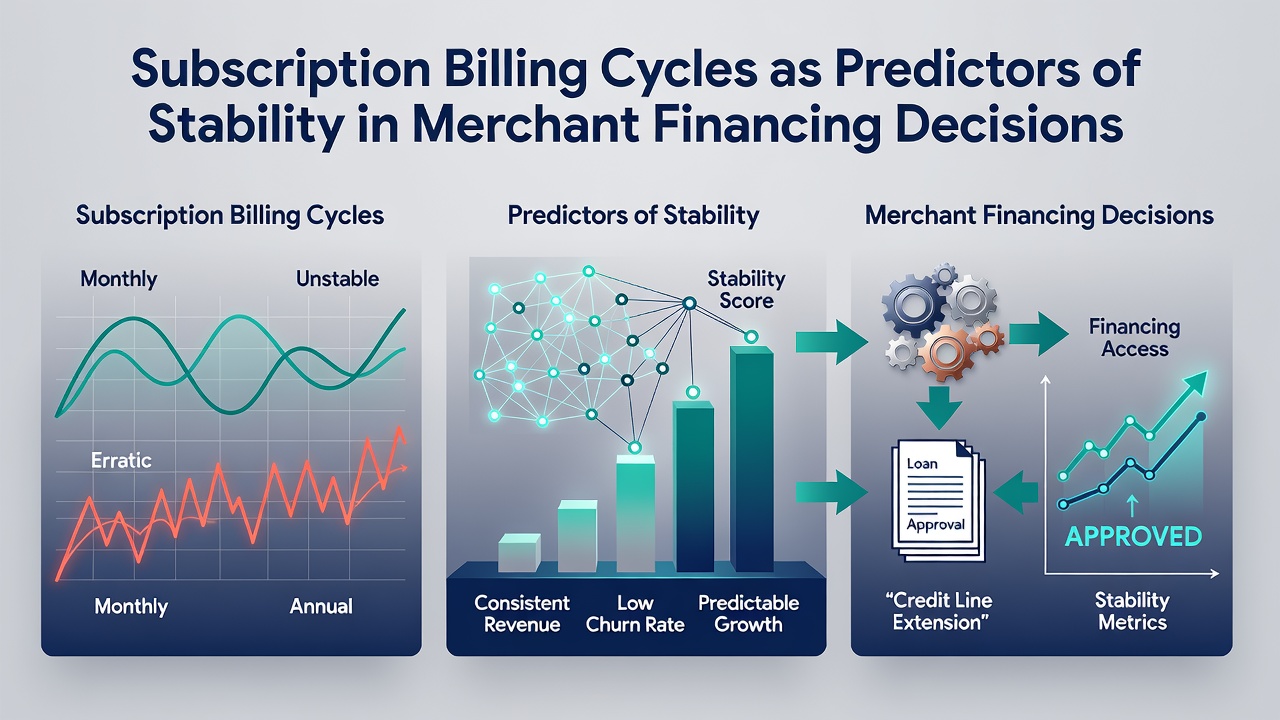
Churn analysis within these cycles further refines the predictive value, since low cancellation percentages signal customer loyalty that extends beyond one-time purchases. Lenders incorporate this information alongside traditional credit scores, using software tools that parse billing platform exports to calculate metrics like monthly recurring revenue and customer lifetime value. Those who've reviewed lending portfolios note that merchants with churn below 5 percent annually often receive faster approvals, as the data reduces uncertainty around cash flow volatility.
Integration with Merchant Financing Underwriting Processes
Underwriters at commercial lenders have begun weighting subscription billing data more heavily when assessing applications from e-commerce and service-based merchants, because these records offer granular insights into operational resilience that point-of-sale transaction histories alone cannot provide. For instance, a merchant with diversified billing cycles across monthly and annual tiers can demonstrate adaptability to market shifts, which supports stronger risk assessments during June 2026 reviews as economic indicators stabilized following earlier fluctuations. Platforms that export billing details directly to financing portals streamline this evaluation, enabling quicker decisions without requiring extensive manual audits.
Geographic variations appear in how different regulatory environments treat this information, with Canadian financial authorities emphasizing subscription retention data in small business lending guidelines issued by the Office of the Superintendent of Financial Institutions. This approach contrasts with practices in other regions where lenders prioritize inventory turnover metrics instead. Merchants operating across borders often prepare unified reports that reconcile these differences to strengthen their applications.
Empirical Evidence from Industry Datasets
Research compiled by the Australian Bureau of Statistics highlights patterns among subscription-driven retailers where consistent billing cycles aligned with improved access to invoice financing products between 2023 and 2025. The figures reveal that businesses maintaining over 80 percent renewal rates secured funding at interest rates averaging 1.2 percentage points lower than peers without such structures. Academic papers from university economics departments have replicated these findings through controlled analyses of anonymized merchant ledgers, confirming the statistical significance of cycle regularity as a stability proxy.
Take one case where a regional fitness studio chain used its annual membership billing data to qualify for expansion capital, with the lender citing the low variance in monthly collections as a key factor. Similar examples surface in software-as-a-service providers that leverage tiered subscription models to build financing eligibility, since the recurring elements create auditable trails that traditional seasonal businesses lack. Observers note that this method has gained traction as more lenders integrate API connections to popular billing platforms for real-time verification.
Challenges and Limitations in Predictive Application
While subscription billing cycles offer valuable signals, they do not eliminate all variables in financing decisions, because external factors like economic downturns or shifts in consumer spending can disrupt even the most regular patterns. Lenders balance these metrics against broader indicators such as overall debt-to-income ratios and market competition levels to avoid over-reliance on any single data source. Reports from the Bank of Canada underscore that subscription-heavy merchants in certain sectors still face scrutiny over customer concentration risks when a few large accounts dominate renewal volumes.
Implementation hurdles also arise when merchants transition from one-off sales to subscription frameworks, since initial setup requires investment in compliant payment infrastructure that may delay immediate financing benefits. Data integration between billing software and lender systems sometimes encounters compatibility issues that slow evaluations, prompting some institutions to request supplementary documentation during reviews.
Conclusion
Subscription billing cycles function as measurable components within merchant financing evaluations by supplying structured revenue data that supports stability assessments across diverse business types. Financial institutions continue refining their models to incorporate these elements alongside established criteria, drawing on reports from entities such as the Federal Reserve Bank of New York and the Australian Bureau of Statistics for calibration. As more merchants adopt recurring models, the role of billing cycle analysis in capital access decisions appears positioned to expand through enhanced data connectivity and standardized reporting practices.